Sunday, December 5, 2010

Oil mat cleanup under way in Orange Beach

Oil mat cleanup under way in Orange Beach

Published: Friday, December 03, 2010, 8:10 PM
ORANGE BEACH, Alabama -- City officials were checking out a mat of oily material found this week on the sea floor just off the beach in about 3 feet of water.
orangebeachseal.jpg
A BP PLC test crew found the substance just east of the Cotton Bayou public beach access, Phillip West, city coastal resource manager, said today.
The mat was about 600 feet wide and very narrow, Tim Tucker, Orange Beach public works director, said. Tucker said BP crews removed about 8,000 pounds of material today and would be back at work on Saturday. He said he looked at the work today and no oil had reached the beach.
“It wasn’t floating up and it wasn’t washing ashore,” Tucker said. “BP knows exactly where it’s at and they’re working to remove it.”
West said that in the four months since the leak from the Deepwater Horizon well was stopped, some oil has mixed with other substances and become heavier, sinking below the surface.
“This wasn’t unexpected in my opinion,” West said today. “The oil just gets worked into a tar or asphalt as it rolled around, becoming buoyancy neutral or heavy enough to sink.”


From HC CREEKKEEPER,
This Phillip West is a real JERK! Orange Beach needs to get rid of this SOB fast!
Mr. West... "
West said that in the four months since the leak from the Deepwater Horizon well was stopped, some oil has mixed with other substances and become heavier, sinking below the surface.

OTHER SUBSTANCES MY ASS. Why is this Orange Beach official afraid to say the words Corexit or Dispersant?
Photo by John L. Wathen


"“This wasn’t unexpected in my opinion,” West said today. “The oil just gets worked into a tar or asphalt as it rolled around, becoming buoyancy neutral or heavy enough to sink.”


Only a fool would make such a moronic statement.
How could anyone say this was "unexpected" when this material mysteriously disappeared?
Photo by John L. Wathen

Submarine Finds Little Life Amid Oil on Sea Floor

Submarine Finds Little Life Amid Oil on Sea Floor


 December 4th, 2010

A mile below the surface in the Gulf of Mexico, there is little sign of life.

“It looks like everything’s dead,” University of Georgia professor Samantha Joye said.
In an exclusive trip aboard the U.S. Navy’s deep-ocean research submersible Alvin, ABC News was given the chance to observe the impact of this summer’s massive oil spill that most will never see. The ocean floor appears to be littered with twigs, but Joye points out that they are actually dead worms and that Alvin is sitting on top of what is considered an 80-square mile kill zone.
Having taken nearly two dozen dives in the Gulf inside the tiny sub that helped discover the Titanic, Joye is leading a team of scientists who are investigating how much oily material is left on the sea floor.
Aboard the Alvin Thursday, Joye said she saw “about three to four inches of material.” The devastation, she said, could last “years or decades.”

“It’s still there and it’s going to degrade very slowly,” she said.
That as BP, the company responsible for the spill, is challenging government estimates that 200 million gallons of crude spill from its runaway well. London-based BP now insists it’s half that.
But 5,000 feet down, the oil appears to be everywhere. The government estimates that less than 25 percent of the oil remains, but these scientists say it’s not gone, just settled at the bottom of the ocean.
And the work they are doing can be dangerous.
“You’ve got two boats out in the middle of the ocean meeting and then you’re transferring people and gear, which is kind of sketchy to being with when it’s calm like this,” said the captain, Scott Sullivan, “but when you get offshore and it’s a little rough, everything tends to be a lot more dangerous and on the water it happens a lot faster. So we’re going to think safety first and teamwork second.”
The boat that launches the Alvin — the Atlantis — is stationed some 50 miles offshore.
Alvin carries weights to drop to the sea floor, turning slowly as it descends. As the submarine drops, the pressure outside increases. And it is cold – the temperature of the near-freezing water. Everyone on board is bundled in layers of sweatshirts and blankets. The habitable part of the sphere is roughly the size of an car’s interior.
But their work, they say, needs to be seen.
For more of this story, see the rest of the report at ABC.com.

Saturday, December 4, 2010

Clearly BP’s Oil is Not Yet Gone, or Forgotten

Huge Oil Mat Washes Ashore in Orange Beach

December 4th, 2010 Clearly BP’s Oil is Not Yet Gone, or Forgotten


WKRG.com News A giant oil mat, nearly an eighth of a mile long, is washing up west of Cotton Bayou in Orange Beach, Alabama, according to a local television news crew.
BP clean up contractors came to the scene when they were notified and brought in heavy equipment to remove the oil. A clean up crew supervisor told WKRG News 5 the tar mat was “submerged,” and wasn’t visible until the incoming tide pushed it on shore.
“When we arrived, we could smell the petroleum product hundreds of feet away,” broadcast reporter Pat Peterson said. “Workers covered their mouths and noses and coughed because of the overwhelming smell.”

The tar mat removal will be an all-day process. Crews will be removing oil until dusk, according to this report.

Friday, December 3, 2010

A Special Report on the BP Gulf Oil Spill

The Gulf of Mexico is Dying

A Special Report on the BP Gulf Oil Spill
By Dr. Tom Termotto
It is with deep regret that we publish this report.  We do not take this responsibility lightly, as the consequences of the following observations are of such great import and have such far-reaching ramifications for the entire planet.  Truly, the fate of the oceans of the world hangs in the balance, as does the future of humankind.
The Gulf of Mexico (GOM) does not exist in isolation and is, in fact, connected to the Seven Seas.  Hence, we publish these findings in order that the world community will come together to further contemplate this dire and demanding predicament.  We also do so with the hope that an appropriate global response will be formulated, and acted upon, for the sake of future generations.  It is the most basic responsibility for every civilization to leave their world in a better condition than that which they inherited from their forbears.
After conducting the Gulf Oil Spill Remediation Conference for over seven months, we can now disseminate the following information with the authority and confidence of those who have thoroughly investigated a crime scene.  There are many research articles, investigative reports and penetrating exposes archived at the following website.  Particularly those posted from August through November provide a unique body of evidence, many with compelling photo-documentaries, which portray the true state of affairs at the Macondo Prospect in the GOM.
http://phoenixrisingfromthegulf.wordpress.com/

The pictorial evidence tells the whole story.

Especially that the BP narrative is nothing but a corporate-created illusion – a web of fabrication spun in collaboration with the US Federal Government and Mainstream Media.  Big Oil, as well as the Military-Industrial Complex, have aided and abetted this whole scheme and info blackout because the very future of the Oil & Gas Industry is at stake, as is the future of the US Empire which sprawls around the world and requires vast amounts of hydrocarbon fuel.

Should the truth seep out and into the mass consciousness – that the GOM is slowly but surely filling up with oil and gas – certainly many would rightly question the integrity, and sanity, of the whole venture, as well as the entire industry itself.  And then perhaps the process would begin of transitioning the planet away from the hydrocarbon fuel paradigm altogether.


It’s not a pretty picture.
The various pictures, photos and diagrams that fill the many articles at the aforementioned website represent photo-evidence about the true state of affairs on the seafloor surrounding the Macondo Prospect in the Mississippi Canyon which is located in the Central Planning Area of the northern Gulf of Mexico.  The very dynamics of the dramatic changes and continuous evolution of the seafloor have been captured in ways that very few have ever seen.  These snapshots have given us a window of understanding into the true state of the underlying geological formations around the various wells drilled in the Macondo Prospect.
Although our many deductions may be difficult for the layperson to apprehend at first, to the trained eye these are but obvious conclusions which are simply the result of cause and effect.  In other words there is no dispute around the most serious geological changes which have occurred, and continue to occur, in the region around the Macondo wells.  The original predicament (an 87 day gushing well) was extremely serious, as grasped by the entire world, and the existing situation is only going to get progressively worse.
So, just what does this current picture look like.  Please click on the link below to view the relevant diagrams and read the commentary:
http://phoenixrisingfromthegulf.wordpress.com/2010/08/03/an-autopsy-of-the-bp-gulf-oil-well-at-the-macondo-prospect/

As the diagrams clearly indicate, the geology around the well bore has been blown.  This occurred because of drilling contiguous to a salt dome(1), as well as because of the gas explosions which did much damage to the integrity of the well casing, cementing, well bore, well head, and foundation around the well head.  Eighty-seven straight days of gushing hydrocarbon effluent under great pressure only served to further undermine the entire well system.  Finally, when it was capped, putting the system back under pressure forced the upsurging hydrocarbons to find weaknesses throughout the greater system, which revealed all sorts of compromised, fractured and unsettled geology through which the hydrocarbons could travel all the way to the seafloor and into the GOM.

(1)“The rock beds in the vicinity of a salt dome are highly fractured and permeable due to stress and deformation which occur as the salt dome thrusted upwards.” (Per BK Lim, Geohazards Specialist)
We also have faults* to deal with in this scenario of which there are both deep and shallow.  Depending on the current vital stats of the blown out well, especially its actual depth; the number, location and severity of the breaches throughout the well system; the pressure at the wellhead; as well as the type and status of geological formations/strata it has been drilled into, these faults will become prominently configured into the future stability of the whole region.  Larger faults can open up much greater opportunities for the hydrocarbons to find their way to the seafloor via cracks and crevices, craters and chasms.  In fact the numerous leaks and seeps throughout the seafloor surface, which are quite apparent from various ROV live-feeds, give testimony to sub-seafloor geological formations in great turmoil and undergoing unprecedented flux.
*“Once the oil gets into the shallow faulted zones, we have an uncontrollable situation.  The place where most of the oil and gas is coming out  is at the foot hills of the continental shelf as shown in figure 134-1 in the article “BP continues to dazzle us with their unlimited magic”.  The discovery by WHOI of the 22 mile long river of oil originated from these leaks.  So the leaks will be mainly along the faults where I have marked (shallow) in “What is going on at West Sirius” and deep strike-slip faults (red line)  on fig 134-1.” (Per BK Lim, Geohazards Specialist)
Just how bad is this situation? There are actually three different ongoing disasters – each more grave and challenging than the previous one – which must be considered when assessing the awesome destruction to the GOM by the Oil & Gas Industry.
I.  A single gushing well at 7o – 100,000 barrels per day of hydrocarbon effluent for 87 days into the GOM at the Macondo Prospect along with two smaller rogue wells
II. Numerous leaks and seeps within five to ten square miles of the Macondo well with an aggregate outflow of an unknown amount of hydrocarbon effluent per day into the GOM
III.  Countless gushers and spills, leaks and seeps, throughout the Gulf of Mexico, where drilling has been conducted for many decades, with an aggregate outflow that can not even be estimated, but is well in excess of any guesstimate which would ensure the slow and steady demise of the GOM.

It is the last scenario which we all face and to which there is no easy or obvious solution.  The truth be told, there currently does not exist the technology or machinery or equipment to repair the damage that has been wrought by the process of deep undersea drilling, especially when it is performed in the wrong place.  Therefore, wherever the oil and gas find points of entry into the GOM through the seafloor, these leaks and seeps will only continue to get worse.  Here’s why:
Methane gas mixed with saltwater and mud makes for a very potent corrosive agent.  Under high pressure it will find every point of egress through the rock and sediment formations all the way up to the seafloor where it will find any point of exit that is available.  The longer and more forcefully that it flows throughout the fractured area, which is dependent on the volume, temperature and pressure at the source of the hydrocarbons, the more its corrosive effects will widen, broaden and enlarge the channels, cracks and crevices throughout the sub-seafloor geology, thereby creating a predicament that no science, technology or equipment can remedy.
Dire realities of the methane hydrate predicament
The Macondo Prospect in the GOM is just one of many throughout the oceans of the world where the seafloor has beds of methane hydrate locked in place by very high pressure and low temperatures.  Likewise, there are myriad repositories and large “reservoirs” of methane clathrates in the sub-seafloor strata, and especially within the more superficial geological formations, which are being greatly impacted by all oil and gas drilling and extraction activities.  It does not take much imagination to understand how the upsurging hydrocarbons are quickly converting the hydrates to gas, thereby causing innumerable “micro-displacements”, the cumulative effect of which will translate to larger “macro-displacements” of rock, sediment and other geological formations.
When you factor in this constant vaporization of methane hydrates/clathrates both sub-seafloor as well as those scattered around the seafloor surface to the existing scenario, this devolving situation becomes that much more difficult to effectively remedy.  With the resulting shifts and resettling and reconfiguration of the entire seafloor terrain and underlying strata occurring in the wake of these dynamics, we are left with a situation that is not going to get better through the use of even more invasive technology and intrusive machinery.
Question: How many times can you grout a seafloor crack that was caused by an underlying superficial fault after drilling into an old mud volcano?
Answer: “In the attempt to seal the oil from oozing through the faults, BP resorted to high pressure grouting.  Basically it is like cementing the cracks in the rock by injecting grout (cement mixture) at high pressure. The way they do this is by drilling an injection hole into the shallow rocks and pumping in the grout. The grout in “slurry” state will permeate into the cracks, cure and seal up the cracks. However it is not working because of the presence of gas and oil. It is like super-glue. You need to clean the surfaces before you apply the glue; otherwise it won’t stick and will come off eventually after a few days or weeks.
That is why we can see a few blown out craters – shown in my article – Is the last rite for the Macondo Well for real?
(Per BK Lim, Geohazards Specialist)
Likewise, how do you fill a newly emerging gash in the seafloor which is caused by a deep fault due to low level seismic activity, or worse, a full blown earthquake?!
Seismic activity in the GOM and the uptick in earthquakes in the
M
ississippi River Basin and surrounding region

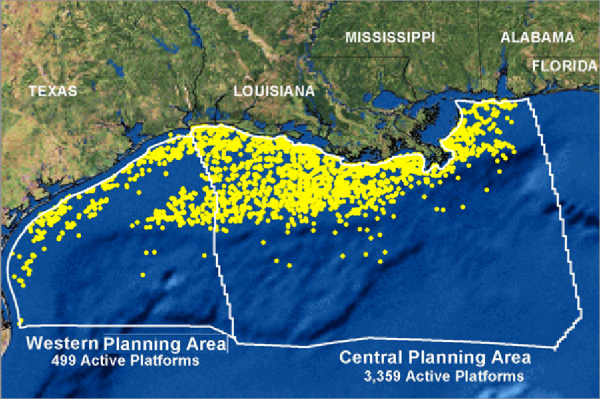
The oil and gas platforms that were in operation throughout the northern Gulf of Mexico in 2006 (per Wikipedia).
We now come to the most serious issue regarding the relentless drilling for oil and gas throughout the Gulf of Mexico.  The map above clearly illustrates the density of drilling throughout the northern GOM as of 2006.  Likewise, the map below demonstrates the extraordinary and increasing intensity of these very same operations off the coast of Louisiana alone.

Green lines represent active pipes (25,000 miles in all). Yellow dots represent oil rigs.
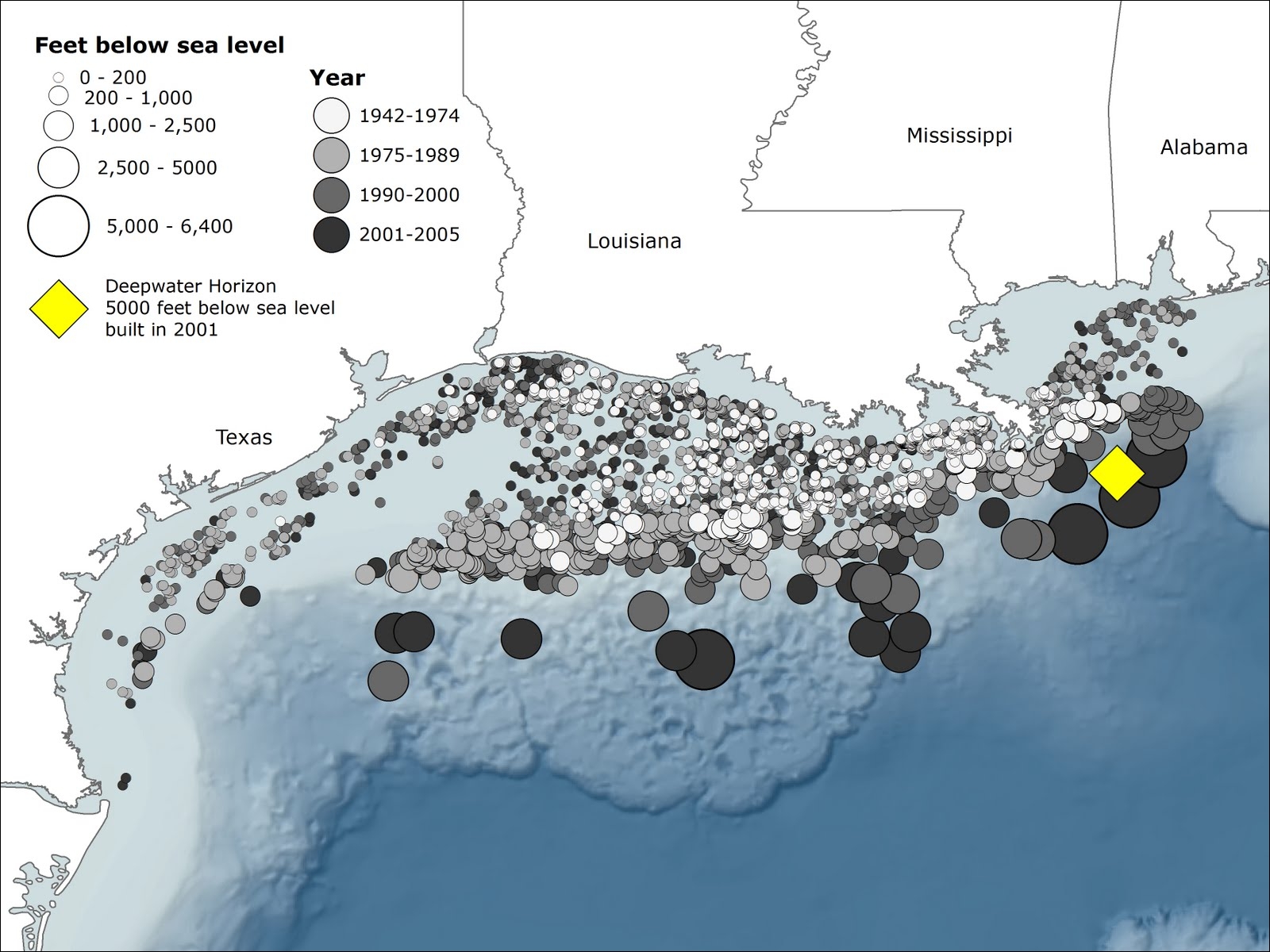
The map that follows, however, tells a story which demands the attention of every resident of the GOM coastline.  The video link below the map shows the development timeline of the successively deeper wells being drilled during the last decade.  Of course, with greater depths come much greater risks, as the technology and machinery have not been proportionately upgraded to accommodate the extraordinary demands and unforeseen contingencies of such a speculative and dangerous enterprise*.
*Oil and gas drilling in seawater depths of over 4000 feet, and through 15,000 to 25,000 feet of the earth’s crust and mantle, is considered extremely dangerous to those from whom reason and common sense have not yet fled.
Click on the map to enlarge.

http://www.youtube.com/watch?v=bh_wNVUx9SI
It’s critical to understand the location and current activity of the various faults which exist throughout the GOM and how they connect to the New Madrid Fault Line, as well as other major faults at much greater distance.  There does appear to be a emerging uptick in earthquake activity in the greater Louisiana area, as well as contiguous regions in the GOM as demonstrated by unprecedented, albeit low level earthquakes.  Correlations between these earthquakes/seismic activity and major operations at the Macondo Prospect have been alluded to in our previous postings.
Now then, the question remains just how vulnerable has the GOM been made to a truly catastrophic event ending up with an overwhelming displacement of water (tidal wave) in the aftermath of an undersea earthquake.
There is no question that the ceaseless fracturing of the seafloor and fissuring of the sub-seafloor geology by the Oil & Gas Industry has set up a quite conducive environment for HUGE unintended consequences.  We leave it up to the experts to conduct the necessary risk assessments, which will most assuredly let loose a sea of red flags about what Big Oil has done, and is currently doing, in the Gulf of Mexico.  Furthermore, we are deeply concerned that, if a permanent moratorium on all new oil and gas drilling and extraction in the GOM is not put into place poste haste, the coastal communities will remain in a very precarious situation.
Worsening GOM predicament is reflective of the status quo around the globe.
Now consider the following scenario: that this very same predicament, which we have all witnessed in the Gulf of Mexico, is happening wherever oil and gas drilling is conducted in the various water bodies throughout the planet.  Therefore we can multiply the Macondo Prospect disaster a hundred times and still not come close to the impacts that these ongoing gushers and spills, leaks and seeps are having the world over.
Perhaps the BP Gulf Oil Spill was the defining moment in modern history when all the nations of the world community were called by Mother Earth herself to begin transitioning the planet away from the Hydrocarbon Fuel Paradigm.  After all, we may never get another chance!
http://www.facebook.com/pages/Transitioning-The-Planet-Away-From-The-Hydrocarbon-Fuel-Paradigm/154984831192787?v=wall&ref=ts
Tom Termotto
Gulf Oil Spill Remediation Conference
OilSpillSolution@comcast.net
SKYPE: Gulf_Advocate
http://oilspillsolutionsnow.org/

Author’s Note: This short reality check was made possible by BK Lim, Geohazards Specialist, whose research and analysis of the BP Gulf Oil Spill has proved invaluable to ferreting out the truth of this unprecedented environmental devastation.
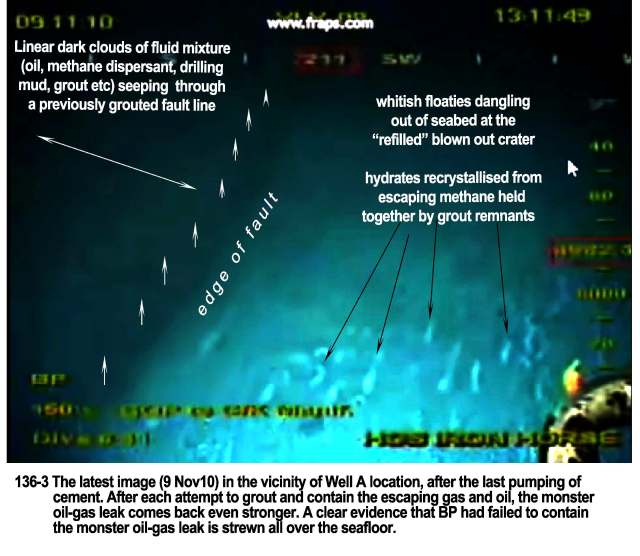
BK provided figures 137-06 and 136-3, including the commentary, which only an experienced and highly skilled geohazards expert could furnish with authority.  He is also responsible for most of the articles/essays referred to and linked to in this post.

ADDENDUM:
There are two very significant topics, which have been not been discussed in this report, that beg for acknowledgement and further attention in light of the title:
The Gulf of Mexico is Dying.
Both of these problems are highly consequential and therefore merit separate papers in order to give them the treatment they deserve, if we are to understand why the GOM is slowly dying.  Until those papers are completed, we offer the following short summaries:

#1  The wanton and indiscriminate use of the dispersant, Corexit, turned an extremely serious disaster into an unmitigated catastrophe.
How many times have we all heard that dispersed oil is at least four times more toxic than oil alone?  Here are the test results from the EPA study, as well as the EPA link:
(1) 10.72 parts per million (ppm) of oil alone will kill 50% of the fish test species in a normal aquatic environment within 96 hours.
(2) 25.20 parts per million of dispersant (Corexit 9500) alone will kill 50% of the fish test species in a normal aquatic environment within 96 hours.
(3) 2.61 parts per million of dispersed oil (Corexit-laden) alone will kill 50% of the fish test species in a normal aquatic environment within 96 hours.

http://www.epa.gov/oem/content/ncp/tox_tables.htm

“Crude oil has proven toxicity at 1 part per million, with constituents like benzene exhibiting genotoxicity in the parts per billion range. The dispersants have made the oil “disappear,” according to the mainstream media, and yet we have marine toxicology documents PROVING that the dispersants PREVENT the natural break…down of some constituents of the oil, e.g. the lesser soluble hydrocarbons such as naphthalene.” (Per Gulf Oil Spill Truth)

Not only is the dispersed oil much more toxic, it is now virtually impossible to remediate in its current micronized or nano-sized state.  Disappeared they did to the oil, and so did they to the various technologies and methodologies which would have been effective in cleaning up oil alone.  Now we are left with a predicament that requires a form of mitigation which must be conceived, before it can be tried and tested.
In the meantime the entire GOM food chain (including those who continue to eat the seafood) is concentrating these newly formed toxic byproducts in their tissues, the effects of which will gradually wend their way through the bodies of each and every organism that is exposed to them.  Just how poisonous to life dispersed oil is we may not know for years, nor does any government-funded research institution seem to be in a hurry to find out!
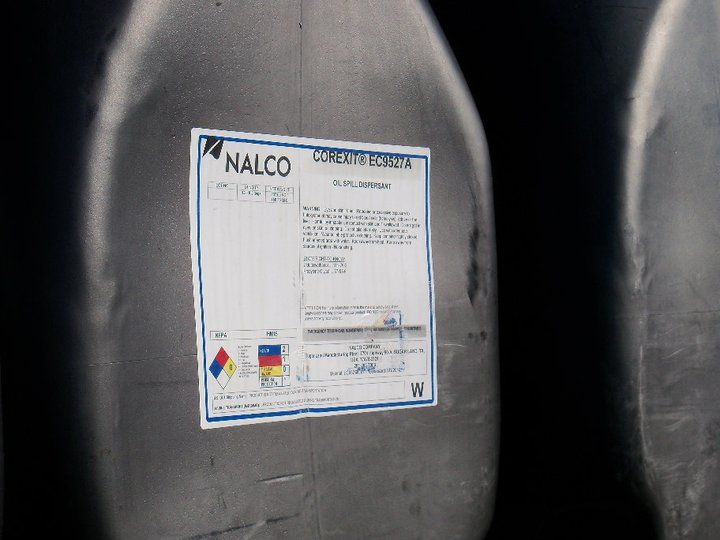
Both Corexit 9500 and 9527 were sprayed liberally for many months both on the GOM surface, as well as undersea.  The officially reported amount is shown below; the covert spraying continues to this very day in volumes which can only be determined by reviewing the disbursement records at Nalco Holding Company.  The photo above (Fig. 137-06) , in addition to much anecdotal evidence, unequivocally demonstrates continued dispersant use up to this very day, which therefore indicates a much higher volume used throughout the GOM.
Surface dispersant used: 1, 072,514 gallons
Subsea dispersant used: 771,272 gallons
Total dispersant used: 1,843,786 gallons


Consider what Wikipedia has to say about 9527: “Corexit 9527, considered by the EPA to be an acute health hazard, is stated by its manufacturer to be potentially harmful to red blood cells, the kidneys and the liver, and may irritate eyes and skin.[14][24] The chemical 2-butoxyethanol, found in Corexit 9527, was identified as having caused lasting health problems in workers involved in the cleanup of the Exxon Valdez oil spill.[25] According to the Alaska Community Action on Toxics, the use of Corexit during the Exxon Valdez oil spill caused people “respiratory, nervous system, liver, kidney and blood disorders”.[16] Like 9527, 9500 can cause hemolysis (rupture of blood cells) and may also causeinternal bleeding.”[4]


Need we say more about how Corexit is contributing to the demise of the GOM?!


#2  The deeper the geological source of the hydrocarbons, the more radioactive isotopes present in the oil and gas.

Thursday, December 2, 2010

Obama bans eastern Gulf drilling for 7 years

By the CNN Wire Staff
December 1, 2010 8:00 p.m. EST
The ban on drilling in the Gulf is a result of the April 20 explosion of BP's Deepwater Horizon drilling rig.
The ban on drilling in the Gulf is a result of the 
April 20 explosion of BP's Deepwater Horizon drilling rig.

Washington (CNN) -- President Barack Obama will not be allowing new drilling in the eastern Gulf of Mexico for at least seven years, Interior Secretary Ken Salazar announced Wednesday.
The exploration of drilling possibilities in sensitive areas of the Arctic will proceed "with utmost caution," he said.
Obama's decision effectively reverses White House plans announced at the end of March to open the Gulf region -- along with other large swaths of U.S. coastal waters -- to oil and natural gas drilling.
Under the plan, roughly two-thirds of available oil and gas resources in the eastern Gulf would have been opened to drilling. Areas located within 125 miles of the Florida coast would have remained off limits.
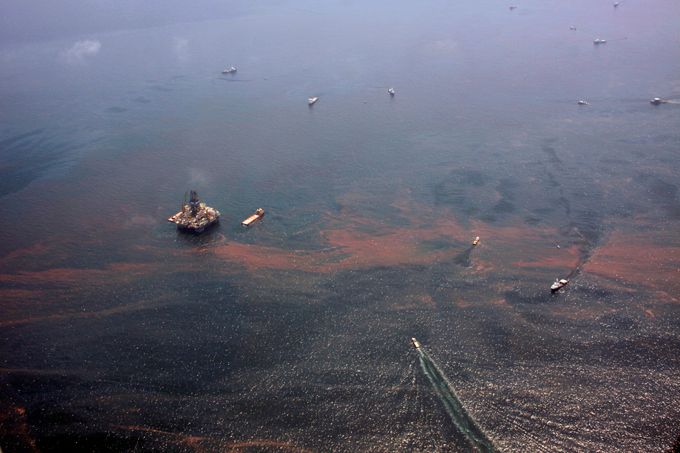
Photo by John L. Wathen, Flight by SouthWings

Salazar said the seven-year ban is being imposed as a result of lessons learned from the April 20 explosion of BP's Deepwater Horizon drilling rig in the Gulf, which killed 11 people and triggered one of the worst environmental disasters in U.S. history.
An estimated 4.9 million barrels (206 million gallons) of oil gushed into the Gulf before the broken well, 5,000 feet below the surface, was capped.
There is a broader recognition of the need for a more "robust safety regime" and additional environmental analysis in the Gulf, Salazar told reporters.
He dismissed concerns that the decision will seriously damage efforts to further develop domestic energy resources, noting that roughly 29 million acres already under leases in the Gulf have not yet been developed.
Rep. Ed Markey, one of the most vocal BP critics in Congress, said the announcement shows the White House "has heeded the lessons of the BP disaster."
"This plan will move America forward on a prudent path until we can ensure that when an oil company drills ultra-deep, it is ultra-safe," the Massachusetts Democrat said. "Opening up wide swaths of our coasts to oil drilling before we put the proper regulatory measures in place would have been a mistake."
Sen. Bill Nelson, D-Florida, said it is "good the president is listening to the people of Florida."
The administration lifted a six-month moratorium on deep-water oil drilling in October.
Salazar has argued that the moratorium provided time to make sure accidents similar to the BP disaster won't occur again, and that rig operators are prepared to deal with worst-case scenarios if they happen.
Critics of the ban, including Republican leaders, Gulf state officials and Gulf Coast residents, said it only hurt oil and gas workers in hard-hit coastal communities, where hundreds of jobs were lost because of the disaster.
Lousiana Gov. Bobby Jindal, a Republican and a frequent critic of the Obama administration's handling of the Gulf spill, said in a statement, "This announcement from the Obama administration today will undoubtedly send more economic capital and even more jobs overseas, in the wake of those oil rigs that already left our waters for Egypt, the Congo and Nigeria during the 'arbitrary and capricious' moratorium on deepwater drilling."
Environmental groups and other supporters of the moratorium argued that it was necessary due to a lack of effective regulation of deep-water drilling that allowed the Deepwater Horizon explosion and subsequent spill to occur.

Gulf Shrimping Decimated

 Thanks to Clean The Gulf for this video

Gulf Shrimping decimated 

Photo by John L. Wathen


Jack Harmon, a career Shrimper, speaks candidly about his experiences before and after the rig explosion on the Gulf of Mexico. I met Jack when he drove up to ask what I was doing. I had my camera on a tripod shooting some establishing shots of the area. While he and his wife and father in law were sitting in the truck, he shared a great deal of information with me about the industry...his observations and feelings before and after the Deep Water Horizon blew up. If during this interview it sounds like I'm asking leading questions, it's because we had previously discussed the subject matter; and, I wanted Jack to restate that aspect of his story.
Bayou La Batre
November 14, 2010

Wednesday, December 1, 2010

BP Oil Well Capped, But Trauma Still Flowing

Marisa Penaloza/NPR

LISTEN HERE...

  Homemaker Lena Hofer, 25, recently went to the community center in Bayou La Batre, Ala., for free food and household goods — and was reluctantly turned away by volunteers when Feed the Children ran out of supplies. "It's really hard when they send you away after you [ask for food], especially when you need it like I do," she says. "I'm about to cry."


November 30, 2010
These are hard times in the hard-working town of Bayou La Batre, Ala. It's known as the state's seafood capital — and it struggled to get back in business after Hurricane Karina.
But once again, the processing plants and shrimp boats lining the bayou are mostly idle after the BP oil spill.
So when Feed the Children trucks recently arrived at the community center, the turnout was huge. About a dozen volunteers worked quickly handing out big cartons packed with food and household goods. Residents had to sign up in advance, so some were reluctantly turned away.
"We're out. We only had 800 cards and 800 boxes of groceries," a volunteer gently tells those without tickets for the day's goods. "I'm sorry, we just don't have any more."
We are very, very close on the edge of losing everything. But, you know, God feeds the birds. How much more does he love us? I have to tell myself that, like, 100 times a day.
No one makes a scene. This is not a place where asking for help comes easily.
"It almost makes you not even want to walk up and ask," says Lena Hofer, 25. "Because of how many times I've had to do this, it's really hard when they send you away after you do, especially when you need it like I do. I'm about to cry. It's hard."
The red circles around Hofer's blue eyes and frail frame are evidence of the toll from the spill.
"I'm a homemaker," she laughs, as if she no longer believes it. "My husband was a shrimper. It's bad. It's put us in a really bad spot."
"We are very, very close on the edge of losing everything," says Aaron Hofer, Lena's husband, holding back tears. "But, you know, God feeds the birds. How much more does he love us? I have to tell myself that, like, 100 times a day."
Lost Everything But Their Children
Aaron and Lena Hofer have been on a downward spiral since the spring. And they are not alone. Now, seven months after BP's oil well exploded in the Gulf of Mexico, researchers say more than one-third of coastal residents are experiencing symptoms of trauma.
Aaron, 27, is a fourth-generation shrimper who lost the lucrative summer season to the BP oil spill. Now the shop where he worked part time picking crab for cash has closed down. The Hofers can no longer pay the rent, have signed up for food stamps, and are bouncing from home to home, staying with relatives.
I lost my job, the boat's broke down, I'm homeless, my wife is living with my mother-in-law, and I'm living on the boat.
"It's taken a toll on us. We've split up twice since this happened," Lena says. "We're just now starting to talk and get back together. Because we've lost our place to live, we have lost our vehicle, we have lost our phones."
They've lost everything but their children.
"I have a 2-year-old and a 4-year-old," says Lena. "They're both boys, and they're the love of my life."
Talking about her boys, Justin and Jordan, puts a smile on Lena's face.
"They make me happier than anybody," she says. "Whenever I'm down about everything that's going on, I just look at them and know that I'll be all right as long as they're still in my life."
The pain is raw in Aaron Hofer when he talks about his boys.
"If somebody takes my kids because I can't help myself — I just, I don't know," he says. "It's hard to think about things like that."
He and the boys climb on a play set at a public park just across the street from the Gulf where he once made his living.
Aaron worked on his uncle's shrimp boat. They had a good week when the waters reopened in the fall, but then broke a winch that hauls in the nets. Aaron says the game's over for this year.
2-year-old Justin 
Debbie Elliott/NPR
Since the Hofers lost everything, Lena says she has noticed behavioral changes in her kids. Justin, who's 2, started biting his fingernails and holds his ears whenever he's feeling stressed.        


Since the Hofers lost everything, Lena says she has noticed behavioral changes in her kids. Justin, who's 2, started biting his fingernails and holds his ears whenever he's feeling stressed.
"I lost my job, the boat's broke down," he says. "I'm homeless, my wife is living with my mother-in-law, and I'm living on the boat."
Aaron tenderly looks at his children giggling around the playground. He says they don't understand what's going on.
"They constantly ask, 'Why we got to stay with Aunt Mimmy? Why do we have to stay with G-granny? Why do we have to stay with Maw Maw? Are we going to Billy's house?' You know. 'I want to go home,' is what they want," he says.
Lena has noticed behavioral changes in her kids.
"They stress out," she says. Her 2-year-old has started biting his fingernails. "And he holds his ears whenever just the stress of life come up. Because he don't even want to hear it, you know, and he's 2. He understands too much."
Children are little sponges — they pick up on everything that happens to their parents, says Shelley Foreman, coordinator of children's services at the Gulf Coast Mental Health Center in Gulfport, Miss.
She says more than one-third of the 80 families they treat report oil-spill related trauma symptoms in their kids, such as anger, irritability or acting out at school.
"They can't use their words because they may not be able to identify what they're feeling, so the only way they know how to tell is by their behaviors," Foreman says. She says the spill has had a spiraling, trickle-down effect that disrupts the functioning of families.

'He's Taking This Harder Than He Took Iraq'
Aaron Hofer is an Iraq war veteran. He's in constant motion as he speaks — cracking his knuckles, munching on peanuts or smoking a cigarette. His wife says she hardly recognizes the "dog-faced soldier" who never used to let anything get him down.
"He's taking this harder than he took Iraq — and he was at death's door every day over there," she says. "And because of him not being able to make it up out of this rut, it's just taking him down further and further. We have problems. We fight."
Aaron Hofer
Debbie Elliott/NPR Aaron Hofer, 27, is an Iraq war veteran and fourth-generation shrimper who lost the lucrative summer season to the BP oil spill. His wife, Lena, says she thinks he's struggling more now than he did in Iraq.

Aaron recalls a recent breakdown. "Oh lord, three weeks ago I had an outburst. I don't know where it came from. I yelled at my wife, her mother. I ended up busting a window," he says.
That didn't happen before, she says.
Tears rolling down his cheeks, Aaron recalls a recent breakdown: "Oh lord, three weeks ago I had an outburst. I don't know where it came from. I yelled at my wife, her mother. I ended up busting a window."
Psychologists all along the Gulf Coast report an increase in the kind of problems the Hofers have — anger, anxiety, sleeplessness and depression.
Since the oil spill, people have been living in a prolonged state of uncertainty, says Steve Barrilleaux, who coordinates adult services at the Gulf Coast Mental Health Center.
"It was totally unexpected, and people had no sense of control or no sense of how extensive the damage was going to be — how long-lasting it was," Barrilleaux says.
And there's still no closure, he says.
Barrilleaux and other psychologists believe they're only seeing a fraction of Gulf Coast residents suffering from trauma symptoms, in part because in many coastal working towns, there's a stigma associated with seeking help of any kind — and particularly for mental health care.
"Part of the spirit of being a commercial fisherman has to do with independent thinking, being your own boss, being in control of yourself," Barrilleaux says. "These people are the last true hunter and gatherers on earth, when you think about it.  They have a sense of — I wouldn't say invincibility — but a sense of self-reliance: 'No matter what, we can handle it.' "
Lena and Aaron Hofer have survived a lot in their seven years of marriage, including Hurricane Katrina. They desperately want to believe they can handle this crisis, too.
Aaron says he grew up hearing that you don't seek help from "outsiders" — you take care of your own. But, he says, that hasn't worked so well since the oil spill.