Wednesday, December 15, 2010

Aging Oil Rigs, Pipelines Expose Gulf to Accidents

[Aging] Kendrick Brinson/LUCEO for The Wall Street Journal"
Oil rigs dating from the late-1980s are still in operation in the Gulf, just off the coast of Dauphin Island, Ala.
GALLIANO, Louisiana—On June 10, 1947, Stanolind Oil & Gas Co. won an auction for the right to drill for oil on a plot seven miles off the Louisiana coast. The company built a spindly steel platform and drilled a well in shallow waters. It struck oil, and in 1950, Stanolind sold its first Louisiana sweet crude for $2.67 a barrel.
More than 60 years later, the West Cameron 45-A platform is, according to government records, the oldest functioning platform in federal waters in the Gulf of Mexico. One of more than 100 structures built in the 1940s and 1950s still in operation, the platform has survived seven Category 2 hurricanes and a major fire.

Growing Old in the Gulf

See when major existing Gulf installations were built and view rigs of operators with 100 or more.
The platform's age may have taken a toll, however.
On Dec. 4, 2009, a severely corroded pipe connecting the structure to a high-pressure gas well gave way during routine maintenance, releasing explosive natural gas into the air. Unlike most modern platforms, this one had no remote shut-off switch. Emergency valves that should have cut off the flow of gas automatically didn't close properly—in part, a subsequent investigation found, because a control panel was caked in bird droppings. Workers who had fled by boat to a nearby platform were finally able to shut down the well.
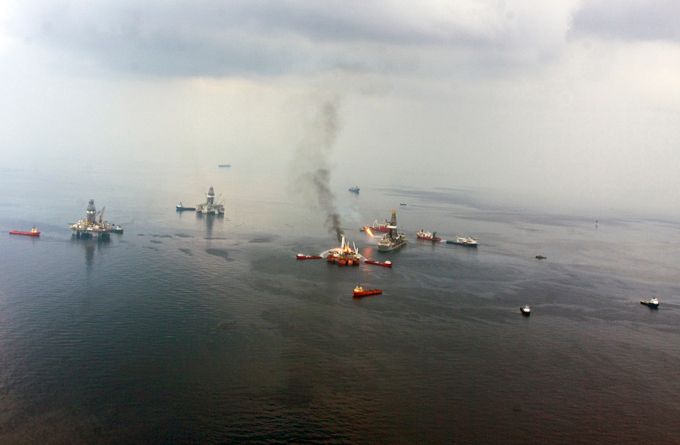
The deadly explosion of the Deepwater Horizon drilling rig in April set off a fierce battle over deep-sea oil drilling aboard huge, state-of-the art vessels. But that debate has largely ignored what many experts say could be a bigger threat: The troubled state of offshore infrastructure that remains in place long after wells are drilled.
High-tech drilling rigs make up only a small piece of the Gulf's energy infrastructure, a vast network of tens of thousands of fixed wells, hundreds of permanent platforms and thousands of miles of undersea pipelines. This network together accounts for nearly a third of the oil produced in the U.S. and more than 10% of the natural gas.
Much of that infrastructure is decades old. Roughly half of the Gulf's more than 3,000 production platforms are 20 years old or more, and a third date back to the 1970s or earlier, long before the development of modern construction standards. More than half have been operating longer than their designers intended, according to federal regulators.
Older structures are more prone to accidents, especially fires, and more dangerous for workers. According to a Wall Street Journal analysis of federal accident records, platforms that are 20 years old or more accounted for more than 60% of fires and nearly 60% of serious injuries aboard platforms in 2009.
"There is an infrastructure issue confronting the industry," says Charles Swanson, a managing partner with Ernst & Young's Oil & Gas Center in Houston. "We're reaching a point now where we're not going to be able to ignore it any longer."
Platforms are subjected to extreme ocean currents, corrosive salt water and frequent hurricanes. Unlike drilling rigs, which are mobile, platforms can't be brought to shore for repairs. Many are so old or have changed hands so many times, that maintenance records are missing or unreliable. And experts say that maintenance work has often gotten short shrift in an industry focused on new discoveries rather than old, declining fields.

The Justice Department is expected to join several civil lawsuits against BP as a way of gaining access to legal documents, which could be used in the government's ongoing investigations, Joe White reports.
Federal regulators investigated 81 accidents at oil-and-gas facilities in the Gulf of Mexico over the past three years in which equipment failure, the most common cause of accidents, was blamed. In more than a quarter of such cases, according to the Journal analysis, investigators found that age or issues that are often age-related, such as corrosion or rust, contributed to the incident.
The government hasn't conducted any studies specifically on the correlation between platform age and incident rates. But in 1998, a broader study on the industry commissioned by regulators and conducted by researchers at Louisiana State University found what they called a statistically significant correlation: A 1% increase in platform age leads to a 0.3632% increase in the rate of accidents. "Thus, we conclude that older platforms indeed pose a greater risk for accidents," the authors concluded.
Pipelines, too, are often decades old and have a history of spills and leaks due to corrosion. Yet offshore lines are subject to lower inspection standards than those onshore; the vast majority of them aren't designed to hold the internal inspection equipment that looks for corrosion, according to federal regulators.
After last year's pipeline rupture on the 1940s platform, federal investigators found there was "extensive metal loss [and] heavy corrosion build-up on the exterior of the pipe" due to "lack of maintenance."
Stone Energy Corp., which bought the platform in 2001, said in a statement that "the overall age of the equipment and infrastructure was not considered to be a factor in the failure." The company said that "as a general rule, older facilities require more upkeep and maintenance than newer facilities," adding, "We prioritize maintenance … with safety of personnel as top priority."
On Tuesday, Stone said it disagreed with investigators' findings and believed its safety devices worked as designed. The company said all its systems met regulators' standards.
Mike Hiner, a deep-water drilling veteran with the engineering firm Hamilton Group, likens old platforms to classic cars, saying they require more maintenance, but can still be run safely. "If it's well maintained, it works," he said.
But industry workers say companies will sometimes cut corners. "Some of the platforms, the catwalks are so rusty you can't get up on them," says Randal Harryman, who worked on platforms in the Gulf for 12 years before retiring when he broke his back on the job in 2005 for reasons unrelated to the age of the platform. "I've been afraid of some of the equipment I've used."
Mr. Harryman, who reached an undisclosed settlement with his employer, says he was mostly stationed on old platforms, many dating to the 1950s and 1960s. He did so-called workover jobs: cleaning out wells, replacing worn-out pipes and plugging up old wells. He says pipes inside wells were routinely so corroded that they broke in two when his crew tried to pull them out.
On a recent Monday in November, a blue-and-white helicopter took off from a small air base here on the southern edge of Louisiana, and flew out over the Gulf. Below, dozens of platforms and structures of all ages and sizes poked out of the water. Rusting tanks sat on wooden docks next to marshland oil wells. Larger, manned platforms stood on steel legs in the shallow water. Farther out, newer platforms floated in deep water.
"You can see the entire history of the offshore industry down there," said Paul Bulmahn, chairman and CEO of ATP Oil & Gas, a relatively small oil company in the Gulf.
Mr. Bulmahn was on his way to ATP's Titan, one of the newest platforms. Designed to operate for 40 years, the 64,000-ton Titan is built to withstand powerful hurricanes, as well as swirling ocean currents that can strain the platform's moorings and eat away at its hull. Every three days, remote-controlled submarines with cameras survey the pipes that connect the platform to wells, looking for wear. The 12 polyester ropes that anchor the Titan to the sea floor contain sections that can be removed and inspected.
Many of the platforms Mr. Bulmahn's helicopter flew over en route to the Titan, however, didn't have such rigorous standards in place when they were installed. Few companies have invested in adding advanced monitoring technology to alert them about corrosion or other developing problems. That means the first sign of trouble is often when a valve blows out or a pipe bursts. Such alarms are common. In 2009 there were 133 fires aboard Gulf rigs, 10 oil spills of more than 50 barrels and 17 releases of natural gas that forced facilities to shut down, according to government data. This past April, two weeks before the Deepwater Horizon explosion, an engine-room fire on a shallow-water rig off Louisiana was blamed on a 33-year-old generator that was "prone to failure due to the engine's service life," according to a federal investigation.
In September, the federal government came out with a new policy on aging infrastructure, announcing that it would step up enforcement of existing rules requiring companies to plug dried-up wells and dismantle unused platforms.
The rules, however, don't do anything to address wells that are still in operation—no matter how old they are.
Nor do they address aging offshore pipelines. While recent onshore pipeline disasters have led to calls for beefed-up regulations onshore, the 25,000 miles of underwater lines that crisscross the Gulf have essentially been ignored. Most of these pipelines are exempt from the kinds of inspections required for pipelines that run through cities and towns.
Yet, ruptured and leaking underwater pipelines have spilled more than 70,000 gallons of oil and other pollutants into the Gulf in more than a dozen incidents in the past three years. A 2007 study found that corrosion is by far the leading cause of offshore pipeline failure.
A 2007 attempt by federal regulators to impose tougher rules for maintaining offshore pipelines was abandoned after opposition from industry groups. In a 232-page rebuttal of the proposed rules, the Offshore Operators Committee argued they were time-consuming, expensive and unnecessary, and questioned the authority of the regulatory agency, the Minerals Management Service, to impose them.
Critics say the failure to adopt new rules on pipelines hints at a broader failure by regulators to force oil companies to maintain their offshore facilities.
"You're exposing people and you're exposing the environment to unmanaged risk," says Tony Hall, CEO of Welaptega Marine Ltd., a Canada-based company that inspects offshore platforms.
Federal regulators say they are strengthening their standards and toughening enforcement of all offshore operations, including those on aging platforms.
"We are aggressively pursuing substantial reforms of our offshore program, including our inspection program," says Michael Bromwich, director of the renamed Bureau of Ocean Energy Management, Regulation and Enforcement, said in a statement. He says his agency needs more funding to ensure compliance.
The extent of the problem was highlighted after Hurricanes Katrina and Rita barreled through the Gulf of Mexico in 2005, leaving behind a tangle of twisted pipelines, toppled platforms and flooded refineries.
Older structures were particularly hard-hit by the storms. Of the 116 fixed platforms destroyed by Katrina and Rita, half were built in the 1960s or earlier and more than 70% were built before 1980.
The storms served as a wake-up call for the industry. Companies stepped up spending on maintenance and monitoring of older structures, and started removing facilities that were no longer profitable.
But experts generally agree that restoring all the old or outdated U.S. energy infrastructure onshore and off is a multi-trillion-dollar problem. And there are forces pushing companies to keep their facilities going for as long as possible. New technologies have allowed companies to pump more oil out of old fields, extending the lives of the platforms and pipelines that serve them. And high oil prices have led companies to try to continue operating fields that, in the past, would have been considered too old to operate profitably.
Says Sampat Prakash, head of the oil and gas division for consulting firm Deloitte: "High prices give people an incentive to keep at it."
Write to Ben Casselman at ben.casselman@wsj.com

Monday, December 13, 2010

Report expose major problems in maintenance, storm preparedness of Louisiana refineries

  "Crossposted from Bridge The Gulf"

Report expose major problems in maintenance, storm preparedness of Louisiana refineries

After Hurricane Gustav in 2007, north Baton Rouge residents were left without electricity for nearly two weeks. Across the street at ExxonMobil’s Baton Rouge refinery, the second largest refinery in the country, workers were dealing with their own mess.
The refinery hadn’t properly shut down before the storm and, as a result, a cooling tower that was still operational toppled over in the winds. More than 500,000 pounds of pollutants were released to the flare, burning for 12 days.
That accident put refinery workers in danger and the fumes and pollutants coming off the flare added another burden to nearby residents. They couldn’t stay inside because of the loss of power and stifling heat, and they couldn’t stay outside because of the toxic chemicals billowing from the refinery.
The accident resulted in a fine from the Occupational Safety and Health Administration and the refinery was required to submit an accident report to Louisiana’s Department of Environmental Quality.
It was one of 2,607 accident reports submitted to LDEQ by the 17 refineries in the state from 2005-2009. The facilities are required to submit them to state authorities within seven days of an accident. But they are rarely as detailed as the story told above. In fact, 20 percent of those reports listed “No Information Given” as the cause of the accident.
Those were the findings of several months’ worth of research and information requests to LDEQ from the Louisiana Bucket Brigade. The analysis of these reports is being released today in partnership with United Steelworkers, the Environmental Working Group and five groups of refinery neighbors across the state.
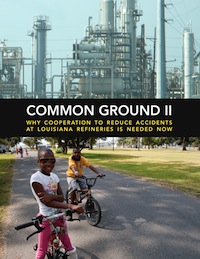
It’s called Common Ground II: Why Cooperation to Reduce Accidents at Louisiana Refineries is Needed Now (download it at labuckebrigade.org), and it exposes problems of deferred maintenance, poor storm preparedness and excessive flaring resulting in more than 21 million pounds and 22 million gallons of toxic emissions across the state over five years.
As a result of slashing refinery workforces and deferred maintenance, problems with pipes and equipment are left unchecked or temporarily fixed. In 2009, OSHA cited Chalmette Refining for ignoring nine safety recommendations on piping, something the refinery hadn’t addressed through six years of citations.
These are disturbing trends in the oil industry – lessons Gulf Coast residents hoped were learned after the BP oil spill. But industry leaders and refinery officials don’t seem to want to address the accident problem, nor do they seem interested in installing emissions reduction technology or other measures that can actually save product during an accident, rather than burn it off at the flare.
In California, refineries saw an 85 percent decrease in emissions thanks to better flare management practices. Dow Chemical in Texas saved $2.5 million worth of product from 2001-2003 by installing flare recovery systems. And the neighboring communities faced less of a health risk as a result.
The groups involved in this study hope refineries seriously consider these recommendations (again, all based on accident reports submitted by refineries), and are calling on refinery officials to work with communities in fixing the problem.
For more on this report, see Louisiana Bucket Brigade’s web site. Also, check out LABB’s Refinery Accident Database, which catalogues all the accident information from 2005-2009.
Benjamin Leger is the monitoring and evaluation specialist and m

Fungus outbreak hits Alabama marshes

Fungus outbreak hits Alabama marshes

Published: Monday, December 13, 2010, 8:00 AM
A widespread fungal outbreak is affecting one of Alabama's key marsh grass species, potentially rendering much of this year's seed crop sterile, according to scientists.
spartina_alterniflora_elmers_island.jpgView full sizeThe fungus affects Spartina alterniflora, one of the two main grasses in Gulf Coast salt marshes. Here, volunteers plant Spartina alterniflora on Elmer's Island in October.
While the fungus is always present in coastal marshes, scientists speculated that repeated exposure to oil sheens from the Gulf of Mexico spill floating on Mississippi Sound and Mobile Bay this spring and summer might have played a role in the outbreak by reducing the natural resistance of the marsh plants to the disease. It is also possible that other factors, such as an ongoing drought, played a more important role than oil, they said.
There are records of the fungus in Alabama and Mississippi marshes dating to 1895, and the scientific literature describes some years where every seed was lost to the fungus, said Judy Stout, who has studied the Gulf's coastal marshes since 1972.
"The marshes and barrier islands were the areas that took the brunt of the oil and sheens," said Judy Haner, marine conservation director with the Alabama office of The Nature Conservancy. "This infection raises the possibility that our marsh system is more vulnerable because it has been stressed. This wasn't like a hurricane, over and done. This area was subjected to months of repeated exposure."
A BP spokesman said that if federal damage assessments found problems in the marshes related to the spill, the company would act appropriately.
Affecting Spartina alterniflora, one of the two main grasses in Gulf Coast salt marshes, the fungus produces deep purple shafts that protrude from individual plant seeds like cat claws coming out of a paw. The fungus, Claviceps purpurea, does not kill the adult plants.
The Press-Register documented the presence of the fungus in marshes along West Fowl River, Portersville Bay, Heron Bay, Raccoon Island and portions of lower Mobile Bay during a survey of 20 miles of shoreline. None of the scientists contacted by the newspaper have surveyed the marshes for the presence of the fungus since the spill. They examined photographs taken by the Press-Register.
"Other than removing the seeds as a source of recolonization for spartina, it's of little consequence to the plant itself. And spartina spreads readily without seeds," Stout said, adding that she was unsure whether oil exposure would act as a source of stress. "Moisture versus dryness and varying degrees of salinity this year might be more important conditions."
Stands of spartina grass along Fowl River itself appeared to be largely free of the fungus, while marshes on the Mississippi Sound were the most affected.
The sound was subject to repeated exposure to oil sheens, as documented in satellite photographs and by Press-Register reporters and oil recovery workers.
This, scientists said, could be the first sign of many subtle problems potentially related to exposure to oil.
Haner said the numerous fungi present in natural systems are normally held in check by plants that are robust enough to fend them off.
"When a system is knocked out of balance, we can see things take off like this," Haner said. "The difficulty will come in quantifying the loss we've suffered. A stressed plant is not something you can easily detect, the way we can see the thousands of pencil eraser-sized tarballs still floating around in our system."
Haner speculated the disease could leave delicate coastal marshes more vulnerable to erosion, as spartina is one of the main plants holding the soft marsh mud in place. In Alabama, spartina is often present at the fringes of the marsh, as it is better able to withstand oncoming waves. Spartina often provides shelter to the black needle rush grass that makes up the bulk of the marsh.
Stan Senner, who served as Alaska's science coordinator following the Exxon Valdez spill and is now the director of conservation science for the Ocean Conservancy, likened the situation in the Gulf to a human immune system affected by stress.
"It is certainly reasonable that exposure to oil may have weakened these plants and made them vulnerable to this fungus or other diseases," Senner said. "People talk about the collapse of the herring population years after Exxon Valdez. Well, one of the agents of that collapse was a fungus that struck the fish. Exposure to oil (for fish born the year of the spill) made them more vulnerable to the fungus."
Senner said the potential link between the fungus and the spill suggests that similar, seemingly unrelated problems may crop up for years to come.
"This story will play out over several years," he said. "Anyone who thinks we have dodged all the bullets in terms of impacts from the spill is being way too premature."
Ray Melick, a BP spokesman, said the spill has heightened awareness of the environment, which may breed questions about the oil's effects. "We have complete faith in the scientists who have spent their lives studying this region," he said. "If it is related to the spill, that's part of what the Natural Resources Damages Assessment process is there to determine, and we are committed to that process."
Bill Finch, director of the Mobile Botanical Gardens, visited the affected marshes and said it looked like something in the marshes had "gone haywire" this year.
"There are many reasons plants get infected by disease, but I was stunned by how pervasive this seems to be this year," Finch said. "That raises questions about spartina being able to recover from the spill, and it raises questions about the relationship with the spill and the outbreak. We need to investigate whether the unusual events of the past year might have stressed the plants and left them more vulnerable."
Ben Raines of the Press-Register wrote this report.

Saturday, December 11, 2010

Netted tar balls close deepwater shrimp fishing

NEW ORLEANS – An area off the Gulf Coast hit hard by the BP oil spill was closed Wednesday to fishing for a deepwater shrimp species after a skipper hauled up tar balls in his net, federal regulators said.
The National Oceanic and Atmospheric Administration said it was closing 4,213 square miles to royal red shrimping "out of an abundance of caution." Royal red shrimp are caught by only a handful of fishermen and they are not one of the main species found on tables across the Gulf Coast. The closed area is one of only a handful of spots where fishermen catch royal red shrimp.
The closed area is off the coasts of Louisiana, Mississippi, and Alabama and lies just north of the BP PLC well that leaked more than 170 million gallons of oil into the Gulf. The leak was set off by an April 20 oil rig explosion that killed 11 workers.
An Alabama skipper reported finding about a half-dozen tar balls in his net Nov. 20, said Karrie Carnes, a NOAA spokeswoman. It took several days to confirm the findings and issue an emergency closure, she said. During that period, she said royal red shrimp fishermen were told about the pending closure and officials made sure no royal red made it to market.
NOAA said the Coast Guard was analyzing the tar balls to determine if they came from oil spilled after the Deepwater Horizon rig explosion.
John Stein, the director of NOAA's seafood safety program, said inspectors at a Pascagoula, Miss., laboratory, where Gulf seafood has been tested since the spill, found no evidence of oil on the shrimp the Alabama fisherman hauled in with the tar balls.
"There was no odor of oil on the shrimp," Stein said.
Royal red shrimp live in deeper waters and about 250 fishermen are licensed to catch them in the Gulf, but NOAA said only a handful of fishermen are working at the moment. Those type of shrimp are caught by dragging nets across the bottom of the seafloor. NOAA said fishing is still allowed in shallower waters in the closed area.
George Barisich, the head of the United Commercial Fisherman's Association in Louisiana, said he was not surprised by the discovery of tar balls. Barisich does not catch red royal shrimp.
"What did they expect? It all went away?" Barisich said, deriding federal and state officials for repeatedly saying the oil was gone as they reopened the vast majority of the Gulf in recent weeks.
"The more people who go to work, the more we'll find," Barisich said. "The reason we're not finding (the oil) is because" so few fishermen are working.
Roy Crabtree, a NOAA official who oversees fisheries in the Gulf, said there have been no other reports of tar balls.
Stein said NOAA would send boats to the closed area next week to do sampling. He said the area would be reopened to royal red shrimping only once it was deemed safe.
The only area still closed to fishing due to the spill is a 1,041 square mile patch immediately around the BP well site. At the height of the spill in June, about 37 percent of the Gulf was closed to fishing, an area measuring 88,522 square miles.

Royal Red Shrimp Collected by Commercial Fisherman in Open Gulf Waters Contaminated with Dangerous Levels of Petroleum Hydrocarbons

NEW TEST RESULTS: Royal Red Shrimp Collected by Commercial Fisherman in Open Gulf Waters Contaminated with Dangerous Levels of Petroleum Hydrocarbons

  • December 10, 2010 2:42 pm

We’ve noted them individually but let’s connect some dots, because three huge news items are making the rounds that support claims that BP’s massive dispersant use hid much of its spill by sinking the oil to the sea floor.
Here’s how a few big relevant stories broke recently (then we’ll get to our troubling new test results):
  1. Shrimp boat pulls up a large load of tar balls while fishing for royal red shrimp in legal open Gulf waters in late November (see article here: http://news.yahoo.com/s/ap/20101125/ap_on_bi_ge/us_gulf_oil_spill_gulf_closure);
  2. NOAA re-closes 4,000 square miles to royal red shrimp fishing west and north of the Macondo well site, representing the first major NOAA backtracking on its relentless “what oil?” and “the seafood is safe” messages; and then
  3. Independent scientists aboard Navy sub, Alvin, find evidence that dispersant use has caused BP’s oil to settle to the ocean floor, killing bottom-dwelling sea organisms en masse (see article here: http://online.wsj.com/article/SB10001424052748704447604576007761183035214.html).
We should note that royal red shrimp are caught in deep water by dragging nets along the ocean floor.
A recent Times-Picayune report quoted NOAA’s Roy Crabtree, the assistant administrator for the federal Fisheries Services southeast region: “We are taking this situation seriously. This fishery is the only trawl fishery that operates at the deep depths where the tar balls were found and we have not received reports of any other gear or fishery interactions with tar balls.”
The closure area was re-opened to all fishing on Nov. 15. And remember those smell tests? Government officials used the infamous “sniff” test on shrimp, reportedly including royal reds, and the seafood passed the tests. As we’ve noted before, not everybody thinks those tests are worth much.
So, clearly, a lot of the oil sank to the bottom of the Gulf. Thousands of square miles are in question and literally tons of seafood. So much for the official declaration that “the vast majority of the oil is gone” and that Gulf seafood is safe for human consumption. Remember, earlier this week Navy Secretary Ray Mabus pressed all the military services to consume as much seafood as possible.
Before that happens, we should all take a look at the new test results below before bellying up to the raw bar. Our research team got this royal red shrimp sample (see below) in October from a commercial boat fishing west of the Macondo well site in Gulf waters legally open to fishing.
Sample description: Royal Red Shrimp
Sampled on: October 2010 by a commercial fishing captain
Sample location: West of spill site (see map below)
Testing by: ALS Laboratory of Edmonton, Alberta, Canada
This shrimp sample was collected by a commercial fishing boat captain in legal open Gulf waters (see map below). The petroleum hydrocarbon chromatogram of the royal red shrimp was a strong match to petroleum hydrocarbons found in the sea water sample that was taken at the same time and place as the shrimp sample. The top chromatogram is for TPH in seawater, while the lower chromatogram is for the royal red shrimp. The shrimp had total petroleum hydrocarbons at 439 mg/Kg, (PPM), and 58 ug/Kg, (PPB), of naphthalene, a PAH. Additional shrimp samples from Pensacola, FL, had up to 6,520 mg/Kg, (PPM), petroleum hydrocarbons. Shrimp in commerce in Louisiana had up to 8,356 mg/Kg, (PPM), petroleum hydrocarbons, and 17 ug/Kg, (PPB), of PAHs.
These are UNACCEPTABLE levels of contamination for shrimp entering the human food chain.
See lab report here: Royal Red Shrimp Data

Wednesday, December 8, 2010

More than 100,000 BP oil disaster claims denied since Thanksgiving

More than 100,000 BP oil disaster claims denied since Thanksgiving

feinberg_hopeSince Thanksgiving, more than 100,000 emergency claims from Gulf Coast residents and business have been denied by Ken Feinberg’s Gulf Coast Claims Facility.
Feinberg’s facility administers the $20 billion fund established by BP to compensate individuals and businesses for economic losses caused by the oil disaster.  Feinberg has spoken of “generous” settlements and quick turnaround on claims, but many locals find fault with his process, especially now that so many claims have been turned down en masse over the past several days.  


All in all, Feinberg has denied 173,000 emergency claims, and compensated 158,000 (though often not at the full amount requested), totaling more than $2.3 billion paid out so far. 80,000 more emergency claims remain under review, and will be approved or denied by December 15th.
November 23rd was the deadline for filing these short-term emergency claims, which cover up to 6 months of lost income.  Feinberg waited until after that deadline to reject more than 100,000 claims that had been "under review," which explains the surge in rejected claims since then.
Michelle Chauncey is one of those denied claimants.  She owns Michelle’s Crab Shack in Westwego, Louisiana, which has been out of business since the end of May. 
michelleMichelle Chauncey.
After filing a claim on October 4th, she waited for two months, knowing only that it was “under review.”  Last week, Michelle's claim was denied because of “insufficient documentation,” which Feinberg cites as a major cause for rejecting claims.


But many claimants counter that the documentation requirements are onerous, especially given that many fishermen deal in cash.
I met Michelle, who also works for the group Louisiana Bayoukeeper, at the Rally for Truth on Grand Isle, Louisiana.  At the rally, Gulf Coast citizens spoke out about how the BP oil disaster continues to harm their health, families, ecosystems, and communities. Many voiced frustration and anger with the Feinberg process, echoing stories of denied claims, waiting in limbo for "under review" claims, or receiving paltry settlements.
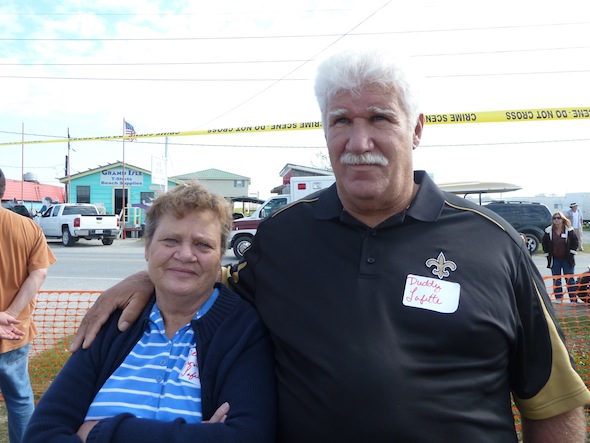
Diane and Glen “Duddy” Poche, who have been shrimpers in Lafitte, Louisiana for 40 years, received a settlement of just $600 to cover six months of losses, after requesting $135,000.  Diane estimates she made thirty emails and forty phone calls to Feinberg’s Facility, but didn't receive an explanation for the measly settlement. She even asked Feinberg himself at a public meeting, and he said could not explain the $600 settlement.
diane_duddy Diane and Duddy Poche
Shortly after the meeting with Feinberg the Poches received another check, this one for $12,000.  

Still, Diane says this falls far short of their needs.  They had anticipated making $200,000 this summer.  Instead they’re trying to stretch $13,000 from the claims process until May, when they can go trawling again (if the harvest rebounds from the oil and toxins in the Gulf, that is). “Now they’re harassing me to do a final settlement,” Diane says.
Unlike the emergency claims for which Michelle and the Poches filed, the final settlements cover projected future losses beyond 6 months, but require people to sign away their rights to sue BP.  As the short-term emergency settlements come to a close, the facility will turn to processing final settlements, and also interim payments, which cover three months of lost earnings at a time and do not require a legal waiver.
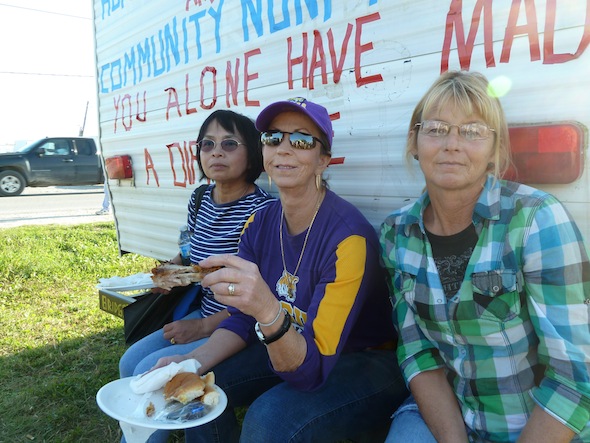
som_betty_darleneSom, Betty, and Darlene of Grand Isle.
Back at the rally, Betty and Darlene, Grand Isle residents, are enjoying some fried turkey, sitting on the bumper of the “Tar Ball Express” (a FEMA trailer turned roving community billboard adorned with phrases like, “Stop feedin’ folks jumbo lies”).  These women make their living cleaning camps (seasonal homes for vacationers and recreational fishermen) on Grand Isle.  Both filed claims with Feinberg, after seeing a significant drop in business over the summer.  Darlene’s claim was denied.  Betty received $6,000 in compensation, compared to her projected (BP-oil-disaster-free) summer income of $20,000.

  Stories like these go on and on. “We’re all named different names, but it’s all the same story,” Michelle Chauncey says.
Clint Guidry of the Louisiana Shrimp Association says the problems with the fund are “purposeful.”  He is particularly concerned about the final settlements that require people to sign away their future rights to sue.  “They’re trying to force people into final settlements,” Guidry says, to allow, “BP, and all the other [companies]... Transocean, Halliburton, to walk away with no responsibility.  I think that’s criminal.”
Those who have been denied for emergency claims can still apply for final and interim settlements.   But it remains to be seen how many will be able to come up with additional documentation, or will willingly reenter such a frustrating process.  Even before her claim was denied, Michelle Chauncey was fed-up with having to, “fill out paperwork, beg for claims,” when all she wants to do is earn money herself, like she did every summer for 18 years before BP destroyed her business.
Ada McMahon's picture
Ada McMahon

Sunday, December 5, 2010

BP lawyers challenge government's size estimate of Gulf of Mexico oil spill

BP lawyers challenge government's size estimate of Gulf of Mexico oil spill


By Steven Mufson
Saturday, December 4, 2010
BP lawyers have said that government estimates of the size of the Gulf of Mexico oil spill are too big, perhaps by as much as 20 to 50 percent, signaling a dispute that will determine how many billions of dollars of fines BP will have to pay under the Clean Water Act.
The BP attorneys made their comments in an Oct. 21 meeting with staff members of the National Commission on the BP Deepwater Horizon Oil Spill and Offshore Drilling, Priya Aiyar, one of the commission lawyers, revealed at a hearing Friday.
The oil giant, in a paper submitted to the presidential oil spill commission, also took issue with one of its draft reports. BP said that the assertion that "a consensus is emerging that roughly 5 million barrels of oil were released by the Macondo well is both premature and inaccurate."
BP said that the estimates by the Energy Department and an inter-agency group "appear biased toward the maximum amount of oil that could have been discharged, rather than the amount of oil most likely to have been discharged."
Photo by John L. Wathen


Penalties for spilling oil start at $1,100 a barrel and can rise to $4,300 if negligence is proved.
Rep. Edward J. Markey (D-Mass.), a sharp critic of the company, said in a letter Friday to BP chief executive Bob Dudley that "BP's new claim that the spill is much smaller than previously thought flies in the face of multiple lines of evidence, and raises questions whether this is a scientific finding, or a litigious position."
The oil company said that government and other academic experts did not properly take into account factors such as temperature differences, the amount of natural gas mixed in, and partial blockages from bent pipes, partial closure of the blowout preventer and from debris.
The company said that the flow rate had increased over time as impediments to the oil were cut away or eroded by the tremendous force of the oil and gas.
BP said that it was still too soon to reach a final conclusion about how much oil leaked from the Macondo well after a blowout sank the Deepwater Horizon drilling rig, killing 11 people.
The government has estimated that 62,000 barrels a day initially gushed from the Macondo well after the blowout, later dropping to 53,000 barrels as the reservoir was depleted. But the flow rate has been a subject of dispute from the early days of the spill, when the government estimated that 5,000 barrels a day were leaking into the gulf.