Friday, March 11, 2011

CHRYSENE FOUND IN FLORIDA WATERS DETECTED BY OPFLEX POM POMS & SWEEPS

For Immediate Release

March 10, 2011


CHRYSENE FOUND IN FLORIDA WATERS
DETECTED BY OPFLEX POM POMS & SWEEPS


Braintree, Massachussets-based Geo Labs has confirmed the presence of Chrysene in the waters in and around Perdido Key, Florida. This substance was detected and absorbed by OPFLEX POM POMS and SWEEPS (OPFLEX is listed on the EPA's National Contingency Plan) submerged near the beach just outside of Eden Condominiums on February 18th, 2011.

Geo Labs CEO, Dave Kahler stated, “We have now built a database of samples from Venice, LA to Pensacola, Florida utilizing EPA testing protocols. This is the first time we have detected Chrysene, which is most concerning as it is showing up in the water close to the beaches
in Perdido Key, Florida.”


"The Clean Water Act (CWA) establishes the basic structure for regulating discharges of pollutants into the waters of the United States and
regulating quality standards for surface waters. The basis of the CWA was enacted in 1948 and was called the Federal Water Pollution
Control Act, but the Act was significantly reorganized and expanded in 1972. 'Clean Water Act' became the Act's common name with
amendments in 1977. Under the CWA, the EPA has implemented pollution control programs such as setting wastewater standards for
industry. We have also set water quality standards for all contaminants in surface waters."

Above is a picture of the OPFLEX with the absorbed oil contaminants that were analyzed by Geo Labs. On February 18th ABC - WEAR TV
Pensacola filmed OPFLEX CEO, Scott Smith deploying the very POM POMs and SWEEPS that detected the Chrysene and subsequently
interviewed Smith after deployment.

The interview and footage from the deployment is posted on youTube at http://www.youtube.com/watch?v=fHECoDtwHXE
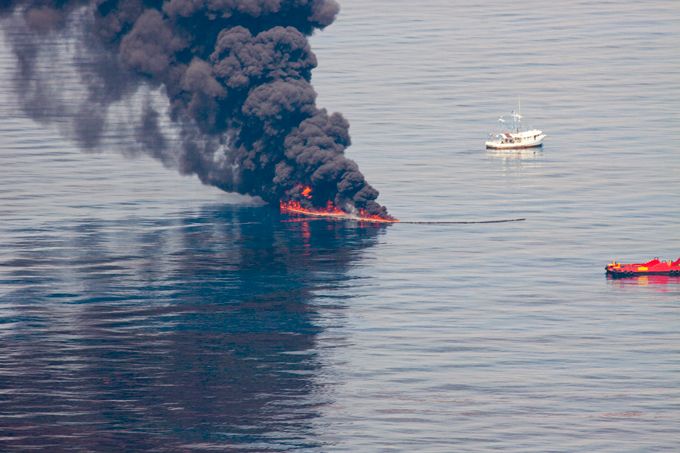
I took the following photos myself of the BP Slick fires at sea where thousands of barrels of crude oil were burned. JLW
Chrysene


Chrysene is one of the polycyclic aromatic hydrocarbon (PAH) compounds. Because it is formed when gasoline, garbage, or any animal or plant material burns, it is usually found in smoke and soot. This chemical combines with dust particles in the air and is carried into water and soil and onto crops. Chrysene is found in the coal tar pitch that industry uses to join electrical parts. It is also found in creosote, a chemical used to preserve wood.

Exposure Pathways

People may be exposed to chrysene from environmental sources such as air, water, and soil and from cigarette smoke and cooked food. Workers who handle or are involved in the manufacture of PAH-containing materials may also be exposed to chrysene. Typically, exposure for workers and the general population is not to chrysene along but to a mixture of similar chemicals.

The general population may be exposed to dust, soil, and other particles that contain chrysene. The largest sources of chrysene in the air are open burning and home heating with wood and coal. Factories that produce coal tar also contribute small amounts of chrysene to the air. People may come in contact with chrysene from soil on or near hazardous waste sites, such as former gas-manufacturing sites or abandoned wood-treatment plants that used creosote. The soil near areas where coal, wood, or other products have been burned is another source of exposure. Exposure to chrysene and other PAHs may also occur through skin contact with products that contain PAHs such as creosote-treated wood, asphalt roads, or coal tar.

People may be exposed to chrysene by drinking water from the drinking water supplies in the U.S. that have been found to contain low levels of the chemical. Foods grown in contaminated soil or air may contain chrysene. Cooking food at high temperatures, as occurs during charcoal grilling or charring, can increase the amount of chrysene in the food. Chrysene has been found in cereals, vegetables, fruits, meats, beverages, and in cigarette smoke.

The greatest exposure to chrysene is likely to take place in the workplace. People who work in coal tar production plants; coking plants; asphalt production plants; coal-gasification sites; smoke houses; municipal trash incinerators; and facilities that burn wood, coal, or oil may be exposed to chrysene in the workplace air. Chrysene may also be found in areas where high-temperature food fryers and broilers are used.

The most common way chrysene enters the body is through the lungs when a person breathes in air or smoke containing it. It also enters the body through the digestive system when substances containing it are swallowed. Although chrysene does not normally enter the body through the skin, small amounts could enter if contact occurs with soil that contains high levels of chrysene (for example, near a hazardous waste site) or if contact is made with heavy oils containing chrysene.

Health Effects

Chrysene causes cancer in laboratory animals when applied to their skin. This finding suggests that it is likely that people exposed in the same manner could also develop cancer. Because studies of chrysene are not complete, we don't know if chrysene that is breathed in or swallowed could cause cancer or if it can cause harmful effects other than cancer.

Information excerpted from
Toxicological Profile for Chrysene March 1990
Agency for Toxic Substances and Disease Registry
United States Public Health Service


copyright michael habeck

Thursday, March 10, 2011

Nungesser To Coast Guard: 'This Is Bulls*!t' - Video - WDSU New Orleans

Nungesser To Coast Guard: 'This Is Bulls*!t' - Video - WDSU New Orleans

Please pass this information along, so this information does not die along with the Dolphins!

Here is the link to an interesting video regarding the deaths of the dolphins in the MS Gulf Coast.

Please pass this information along, so this information does not die along with the Dolphins!


Dead Dolphin 01/31/11 Katrina Pass, Alabama


Gulf spill sickness wrecking lives

Gulf spill sickness wrecking lives
Nearly a year after the oil disaster began, Gulf Coast residents are sick, and dying from BP's toxic chemicals.
Last Modified: 09 Mar 2011 15:42 GMT  
Aljazeera

National and State Parks along the Gulf Coast have posted health warnings along the coast [Erika Blumenfeld/AJE]


"I have critically high levels of chemicals in my body," 33-year-old Steven Aguinaga of Hazlehurst, Mississippi told Al Jazeera. "Yesterday I went to see another doctor to get my blood test results and the nurse said she didn't know how I even got there."
Aguinaga and his close friend Merrick Vallian went swimming at Fort Walton Beach, Florida, in July 2010.
"I swam underwater, then found I had orange slick stuff all over me," Aguinaga said. "At that time I had no knowledge of what dispersants were, but within a few hours, we were drained of energy and not feeling good. I've been extremely sick ever since."
BP's oil disaster last summer gushed at least 4.9 million barrels of oil into the Gulf of Mexico, causing the largest accidental marine oil spill in history - and the largest environmental disaster in US history. Compounding the problem, BP has admitted to using at least 1.9 million gallons toxic dispersants, including one chemical that has been banned in the UK.
According to chemist Bob Naman, these chemicals create an even more toxic substance when mixed with crude oil. Naman, who works at the Analytical Chemical Testing Lab in Mobile, Alabama, has been carrying out studies to search for the chemical markers of the dispersants BP used to both sink and break up its oil.
Poly-aromatic hydrocarbons (PAHs) from this toxic mix are making people sick, Naman said. PAHs contain compounds that have been identified as carcinogenic, mutagenic, and teratogenic.
"The dispersants are being added to the water and are causing chemical compounds to become water soluble, which is then given off into the air, so it is coming down as rain, in addition to being in the water and beaches of these areas of the Gulf," Naman told Al Jazeera.
"I'm scared of what I'm finding. These cyclic compounds intermingle with the Corexit [dispersants] and generate other cyclic compounds that aren't good. Many have double bonds, and many are on the EPA's danger list. This is an unprecedented environmental catastrophe."
Click for more coverage of the BP Oil Spill, including the other segments of the 8-part series, Fatal Fallout. 
Aguinaga's health has been in dramatic decline.
"I have terrible chest pain, at times I can’t seem to get enough oxygen, and I'm constantly tired with pains all over my body," Aguinaga explained, "At times I'm pissing blood, vomiting dark brown stuff, and every pore of my body is dispensing water."
And Aguinaga's friend Vallian is now dead.
"After we got back from our vacation in Florida, Merrick went to work for a company contracted by BP to clean up oil in Grand Isle, Louisiana," Aguinaga said of his 33-year-old physically fit friend.
"Aside from some gloves, BP provided no personal protection for them. He worked for them for two weeks and then died on August 23. He had just got his first paycheck, and it was in his wallet, uncashed, when he died."
National health crisis
Many of the chemicals present in the oil and dispersants are known to cause headaches, nausea, vomiting, kidney damage, altered renal function, and irritation of the digestive tract. They have also caused lung damage, burning pain in the nose and throat, coughing, pulmonary edema, cancer, lack of muscle coordination, dizziness, confusion, irritation of the skin, eyes, nose, and throat, difficulty breathing, delayed reaction time and memory difficulties.
Further health problems include stomach discomfort, liver and kidney damage, unconsciousness, tiredness/lethargy, irritation of the upper respiratory tract, hematological disorders, and death. Pathways of exposure to the chemicals are inhalation, ingestion, skin, and eye contact.
Al Jazeera has talked with scores of sick people across the Gulf Coast who attribute their illnesses to chemicals from BP's oil disaster.
Paul Doom, 22, from Navarre, Florida, was training in preparation to join the US Marines, until he became extremely ill from swimming in the Gulf of Mexico.
"I stopped swimming in July because I started having severe headaches that wouldn’t go away," Doom told Al Jazeera. "But each time I went to the doctor they dismissed it."
In October, Doom began to have internal bleeding, but this too was dismissed by doctors. In November, when it worsened, he was given pain medications in the Emergency Room and was told it would pass. Less then three weeks after that, Doom collapsed with a seizure.
"Since then, I've had two blood tests for Volatile Organic Compounds [VOC's] which are in BP's oil and dispersants, and they both came back with alarmingly high levels," he said.
Children playing in the surf at Orange Beach, Alabama, despite independent scientists' warnings of toxins in the water, air, and seafood [Erika Blumenfeld/AJE]
Since the onset of his symptoms, Doom has been dealing with ongoing internal bleeding, nose bleeds, bleeding from his ears, blood in his stool, headaches, severe diarrhea, two to five seizures per day, paralysis in his left leg and arm, and failing vision.
"A toxicologist that interpreted my blood VOC results told me they didn't know how I was alive," Doom explained. "My Hexane was off the charts, and I have 2 and 3 Methylpentane, Iso-octane, Ethylbenze, and mp-Xylene."
Wilma Subra, a MacArthur Fellow and chemist in Louisiana, has been testing the blood of BP cleanup workers and residents in Louisiana, Mississippi, Alabama, and Florida. Subra tested Doom's blood and found high amounts of several VOC's.
"Ethylbenzene, mp-Xylene and Hexane are volatile organic chemicals that are present in the BP crude oil," Subra told Al Jazeera. "We're finding these in excess of the 95th percentile, which is the average for the entire nation. Sometimes we're finding amounts 5 to 10 times in excess of the 95th percentile."
Subra explained that there has been long enough exposure so as to create chronic impacts, that include "Liver damage, kidney damage, and damage to the nervous system. So the presence of these chemicals in the blood indicates exposure."
Testing by Subra has also revealed the chemicals are present "in coastal soil sediment, wetlands, and in crab, oyster and mussel tissues."
Staggering toll
Since January, at least 67 dead dolphins have washed ashore along the Gulf Coast, an event the National Oceanic and Atmospheric Administration declared as "an unusual mortality event". In the whole of 2010, 89 dolphin deaths were reported for the same area.
In January, a Woods Hole Oceanographic Institute chemist and colleagues reported that the toxic chemical dispersants BP used to sink its crude oil remained in the deep ocean in an oil and gas-laden plume that had still not degraded.
Also in January, Louisiana Senator AG Crowe wrote a letter to President Barack Obama expressing his deep concern about the toxic dispersants BP used, and according to Senator Crowe, continues to use along the Gulf Coast.
"Mr President, my concern is that this toxic and damaging chemical is still being used and it will compound the long-term damage to our state, our citizens, our eco-system, our economy, our seafood industry, our wildlife and our culture," the letter read.
"We will not be fooled in to believing that the oil and the toxins are gone. Because the toxic dispersants have been, and are still being used today, the oil is being forced downward in to the water columns and then carried endlessly around and about by the Gulf currents adversely affecting our environment."
Subra, the MacArthur Fellow, is alarmed by what she is finding in the people whose blood she is testing.
"Severe symptoms, lots of respiratory and cardiovascular problems, and skin lesions," she explained. "There is a lot of internal bleeding, and the chemicals cause this by disrupting the integrity of the red blood cells."
Subra said: "We’re seeing the chemicals in different classes of people. Cleanup workers employed by BP, clean-up workers no longer employed, and we’re seeing it in community members who come in contact with the crude by fishing or recreating in the Gulf."
Al Jazeera asked Subra what she thought the local, state and federal governments should be doing about the ongoing chemical exposures.
Tar mats remain along large swaths of coastal Louisiana [Erika Blumenfeld/AJE]
"There is a lack of concern by the government agencies and the [oil] industry." She said, “There is a leaning towards wanting to say it's all fixed and let's move on, when it's not. The crude oil is continuing to come on shore in tar mats, balls, and strings."
Subra continued: "So the exposure continues. There is still a large amount of crude in the marshes and buried on the beaches. As long as that pathway is there for exposure, these problems will continue quite a long time into the future."
A bunch of guinea pigs
Jo Billups is an environmental activist who has taken it upon herself to assist in the funding, along with her friend Michelle Nix, in the blood testing being carried out by Subra.
Working with the Louisiana Environmental Action Network and several doctors along the Gulf Coast, Billups and Nix have been holding workshops and helping sick people get their blood tested and find medical assistance.
"We have sick people from Apalachicola, Florida, to Grand Isle, Louisiana, and it's not stopping and that's what's disturbing," Billups said. "The levels we are seeing are not dropping, and we're seeing new chemicals now. We gave some of our blood test results to [EPA head] Lisa Jackson. They know what is going on, and they are not doing anything about it."
"The saddest part is the children," Billups added. "We’re seeing young children with extremely high levels of chemicals. We're altering our DNA and our bodies forever, We're a bunch of guinea pigs."
Jennifer Rexford, from Panama City, Florida, was an oil clean-up worker for BP.
"We were taken to clean up oil and tar balls with inadequate equipment," Rexford told Al Jazeera. "We regularly got oil all over us."
Rexford now has a staph infection that covers much of her body that she attributes to the chemicals in BP's oil she was cleaning up.
"Everyone I know of that I worked with are now having kidney problems, along with lots of other illnesses," Rexford, who has been to the hospital four times trying to find a solution to her infection, said. "My neighbor has a rash all over her body, and another clean-up worker I know found a lump in her breast a month ago. So when I started calling my co-workers, I realized that we’re all sick."
BP cleanup workers regularly are not provided with the proper protective equipment for cleaning up hazardous material such as crude oil [Erika Blumenfeld/AJE]
"I have documentation and images showing lesions in my brain," Paul Doom said. "Lesions that are the same as lesions on the brains of marine life from the Exxon Valdez spill from marine necropsies. This is a life and death situation and a race against time."
Doom said the water and food along the Gulf Coast are not safe, and he is angry at the Obama administration.
"I would ask them why have they allowed this to happen," he said, "How can you live with yourself knowing you allowed this to happen and continue?"
Aguinaga feels betrayed as well.
"I feel stabbed in the back by my own country," he said, "I feel we are being dictated to by a foreign power. Maybe our president is not strong enough to stand up against them. I know money buys people, but they couldn't offer me enough money for the loss of my friend, and the stuff we’re going through."
Aguinaga's prognosis for the future of Gulf Coast residents?
"We’re all lab rats and we didn’t even know it. We’re waiting to see how it’s going to turn out."

Wednesday, March 9, 2011

BP Oil Spill Victims Sickened and Dying, Local Physicians Clueless

BP Oil Spill Victims Sickened and Dying, Local Physicians Clueless

Lisa Nelson of Orange Beach, AL is one of a growing number of people sickened and dying as a result of the BP disaster. Local physicians have no idea how to diagnose or treat patients who have bee exposed to highly toxic crude/dispersant combination. Local, State, and federal agencies continue to cover-up and offer zero assistance.
Very sad; Lisa Nelson passed away today 3.7.11. She was an inspration to all who were fortunate enough to know her and will be dearly missed. God bless her beautiful soul.

Tuesday, March 8, 2011

NASA Data Strengthens Reports of Toxic Rain on the Gulf Coast From BP Spill

NASA Data Strengthens Reports of Toxic Rain on the Gulf Coast From BP Spill 

Along the Gulf Coast, the marketing blitz for spring break is rolling out as the oil from the BP blowout 11 months ago continues to roll in along with increasing numbers of dead infant dolphins, in numbers completely without precedent. The beaches remain polluted with toxic oil and dispersant even as local politicians and government officials insist everything is fine and the oil miraculously gone. Thousands of pounds are collected each day from the few areas that remain under scrutiny, all of those being in highly visible resort areas. In one zone on Ft. Morgan beach in Alabama, a record 17,000 lbs was collected in one day after a winter storm rolled through. Along the beaches of Alabama in areas not frequented by media or guests, dead infant dolphins are left uncollected in the sand. Current plans by mayors of resort communities along the Gulf Coast will have thousands of vacationers, including at-risk populations, once again making sandcastles and sunbathing on toxic, polluted beaches.

BP continues to shut down the few cleanup efforts still underway with the approval of the federal government. At the Gulf Coast Ecosystem Restoration Task Force meeting in New Orleans recently, scientists, NGO's, and concerned citizens demanded to know how the ecosystem could be restored when the basic cleanup of the oil has been made impossible by any known technology after the dispersant sank it to the ocean floor. Health concerns remained at the forefront of dialogue as a new report by the Louisiana Bucket Brigade finds that nearly 50 percent of the population along the Gulf Coast is experiencing sickness indicative of chemical poisoning related to the BP oil spill. The CDC assertions in a brochure distributed at the meeting that the levels of chemical exposure related to the spill are not a cause for concern was ridiculed and an embarrassment to many of the officials present.
2011-03-03-P103005320110303at1305061.jpg
Orange Beach, Alabama, March 3, 2011

Government data collected during the oil spill last summer, which is now being released by one of the scientists on the NASA team, strengthens claims that oil and dispersant was brought onshore in rain during the spill. The Chief Mission Coordinating Scientist on the NASA remote sensing mission to the BP oil spill in the Gulf Of Mexico was Ira Leifer, Ph.D from University of California Santa Barbara. Dr. Leifer has been working with natural oil spills and natural methane bubble flows for the last decade. He is in the process of releasing some of the government data collected during the spill; the vast majority of this data has been suppressed and is not available to scientists, the media, or the general public. The data was collected on boats at the sea surface, in airplanes over the Gulf, and by satellite.
The data being released, which was collected by the NASA missions to the Gulf, shows that the toxic compounds released from the BP spill became airborne, and significant quantities were brought onshore by precipitation, thereby exposing coastal populations to chemical poisoning. This represents something new and unique not observed in previous oil spills. It helps explain why there were numerous reports by people living along the Gulf Coast that it was raining oil and dispersant during the summer months.
2011-03-02-Leiferatwork.gif
Ira Leifer at work/Photo by George Foulsham

After spending some time together in New Orleans I spoke to Ira Leifer at length in Mexico City.
IL: I think it is important to establish for the record that the unique aspect of this [BP blowout] is that the volatiles were continuous, it was not a one-day exposure. The chronic nature of the spill and the therefore chronic nature of its health impact is a pretty unique aspect of this event. The reason I think it's important to call it unique is that it gives a way to explain why various government agencies using protocols developed for a single coast spill didn't get it right because it's not the same. I think it's important to give the people we really want to take responsibility a way of saying ah, yes, you're right and jump on the bandwagon with us. We need NIH to fund a 50 to 60 million dollar study because this is something that had never happened before. The data we collected in the atmosphere shows a very high hydrocarbon load and we were able to identify more than 100 compounds in it. Many of them have health implications. There were large amounts of them and they have similarities to gasoline. In that regard the modeling I did seems to suggest that there are reasons for concern. There are reasons to do additional research.
JC: How was the data you are referring to collected, and based on that data, what degree of concentration did you find of what you would consider toxic compounds?
IL: That is a top question because realistically they are probably all toxic to some extent. But for so many compounds I do not think the studies have been done to say what precisely the threats are -- it's a mixture. The way we did the measurements we had evacuated stainless steel 1 liter cylinders opened up to very gradually and gently allow air to enter into the container and then sealed. These were collected on a boat and also in NOAA airplanes and then analyze by a scientist Don Blake at his laboratory at UC Irvine. The concentrations of any one compound were very low in the parts per billion (PPB) or even less. But many of these concentrations were at sea and this is a good comparison, higher -- much much higher than in Mexico City where I am now and is one of the standards for the worst air pollution in the world. This is what is being experienced or observed and breathed by people on site. The response workers were not wearing a mask [respirator].
JC: What about the population along the coast in the areas where there have been so many reports of people complaining of health problems, specifically Southern Louisiana, Mississippi, the Orange Beach/Gulf Shores area of Alabama? Do you think the data you collected has a direct correlation to those populations and what they were inhaling?
IL: People in the Gulf of Mexico were not warned that the air was going to be bad and they had clean air in much of the area right before the spill. It is a very different kind of situation than people who chose to go and try to make money in Mexico City. A lot of people in the Gulf live there because they enjoy the Gulf and they didn't want to move Los Angeles or New York City or the big American polluted environments -- they chose to stay where the environment is pretty clean. In terms of the health implications for coastal communities I think there are two things. I have classified there being three different approaches by which atmospheric phenomenon related to the oil spill can cause health effects. One is the volatiles just breathing the stuff a long way from the incident site. A second one is aerosol, so when oil comes up on the beaches as the wave breaks there is aerosol generated in the air, and that can be breathed by people. The last one which we discovered is the rain. I will add a fourth one which is dispersants. Clearly, spraying dispersants near populated areas is a bad idea. If dispersants are aerosolized that is a bad thing as well. I do not have data on the dispersants so I will speak to what I do know. With regards to the volatiles there are two things the main thing is that volatiles can go a long way on the wind. I did some simple calculations of quantities and exposures in coastal communities. What I saw according to OSHA rules absolutely no problem. If one assumes the volatiles can be health effect modeled as gasoline exposure there is a potential - the dosage rates were high enough for there to be problems. When I did it for healthy adults it seemed worth looking at, but who knows. The big worry is pregnant women and the elderly -- at risk populations. In that regard, at-risk populations, the levels seem to suggest there could be really severe concern for the health-related impacts. What that implies is that it really needs to be studied and looked at. The [published] literature is for people exposed long term to gasoline.
The other way is the aerosols. The aerosolization are really tiny droplets smaller than a hair but still pretty large, and they can not stay airborne for very long before they will fall back down to the ground. Maybe a couple of miles inshore. So you would expect people right near the beach would be at risk from aerosol related problems. But once you got 5 to 10 miles onshore it would go back to people just breathing and smelling fumes rather than the aerosol component. Aerosols and their effects are a little uncertain, exactly what it is going to do. We know that aerosolization in past spills always cause a lot of people to get sick. In this spill, probably the same. They are droplets that are large enough that if they get into your lungs your body can potentially remove them, or maybe not because they are tar so it may get stuck in there. I do not know of literature in detail on this in the U.S., there may be overseas. If you breathe in aerosols of oil do you cough them out and get rid of them within a month or do they stay in your body for years? That is a very important distinction.
What you would expect to see is that people within close proximity to the beach -- with a mile or two -- would have symptoms different from people ten miles from the beach. And when I say beach it is also shoreline.
The last one is the rain. That is a completely new phenomenon that has not been reported. People at California Oil Spill who have done testing on burning have never seen anything like that. But you don't have 102% humidity in California. There is no precedent in past oil spills to consider to know that this is a problem and what its effects are.
JC: Part of the data set you collected definitely showed that it (VOCs) was present in precipitation?
IL: Not in precipitation. I know there were clouds filled with hydrocarbons. This is from the remote sensing data showing that a cloud -- maybe it is 1/2 mile thick -- had about .1 or .2mm of oil equivalent in it spread out through the whole thing. When it rains, whatever is in it is going to come down, that is just how clouds work. I don't have documentation on the rain. On the other hand there are quite a few anecdotal reports of people saying it's raining oil. What was missing was any explanation of how that could be happening, a scientific mechanism. What my data does is that it elucidates the mechanism scientifically so we can explain exactly how this could happen. It goes from speculation that just have been a water spout and it pushed the oil up into the atmosphere and then somehow it came down in Alabama to actually a very clear connection that can both be studied from the remote sensing data we have and also from people's observations. This would be a cause for concern in the future and burning oil from spills as to whether or not it's a good idea.
JC: Going forward, based on the path the data is leading you for further investigation what would you like to see happen now?
IL: For myself there are two. To improve the atmospheric model. But more to the point the most important link that needs to be made at this point is that chronic gasoline exposure is a good health model of exposure to the BP oil spill fumes. Secondly to try and get a better understanding -- which seems to be impossible -- what is known about the airborne impacts of the oil spills in the last 10 years around the world. We live in a global world and society, it is silly for us not to learn from the experiences of our friends in Europe who have also experienced oil spills in recent years and documented widespread health impacts. As Americans, if we can learn from them we can avoid the mysterious Gulf Coast Health Syndrome appearing five years from now that nobody figures out what it is until 10 years from now with a lot of people getting sick and very ill in the interim.
 
Follow Jerry Cope on Twitter: www.twitter.com/jercope

Sunday, March 6, 2011

Oil rig fire in Gulf of Mexico sends 2 rig workers into water

Oil rig fire in Gulf of Mexico sends 2 rig workers into water

Published: Sunday, March 06, 2011, 12:47 PM     Updated: Sunday, March 06, 2011, 6:27 PM
Cherie Ward - The Mississippi Press By Cherie Ward - The Mississippi Press gulf-oil-rig-fire.jpgView full sizeA fire burns on board the GI 102A oil production platform 50 miles south of Grand Isle, Louisiana on March 6, 2011. The Coast Guard responded with multiple sea and air assets to the reports of the fire, rescuing 2 individuals who were on board the platform at the time. (U.S. Coast Guard Photo)
PASCAGOULA, Mississippi -- An official with the U.S. Coast Guard confirmed that a fire broke out Sunday morning on an oil rig 50 miles off Grand Isle in the Gulf of Mexico, injuring 2 people but apparently not causing a leak of crude into the water. Petty Officer Steve Lehmann said 2 people were sent into the water at about 11 a.m. when the GI 102A oil production platform owned by Arena off Port Fourchon, La. caught fire.
The 2 men used a life capsule to escape the blaze and were rescued by a nearby fishing vessel and taken to West Jefferson in Marrero, he said
Lehmann said officials do not believe an explosion was involved in the incident.
Lehmann said the rig is near the area where a oil rig leased by BP exploded on April 20, killing 11 people and causing leak that continued through the summer, creating a record oil spill in the Gulf of Mexico.
"We believe at this point that it was not an explosion and only a fire," Lehmann said, regarding Sunday's incident. "We believe those injured are OK."
Lehmann says the fire was out shortly after noon Sunday.
Coast Guard officials were responding Sunday afternoon to verify there was not an explosion, Lehmann said.
"We're still determining if there is any oil leakage," Lehmann said. "When you're putting out a fire, there's a lot of runoff. It's something we're still trying to determine, but early reports are coming back that there is not oil leakage."
Lehmann said there was a 1,000-yard secured area around the platform, and there was a temporary flight restriction 5,000 feet from the platform Sunday afternoon.